
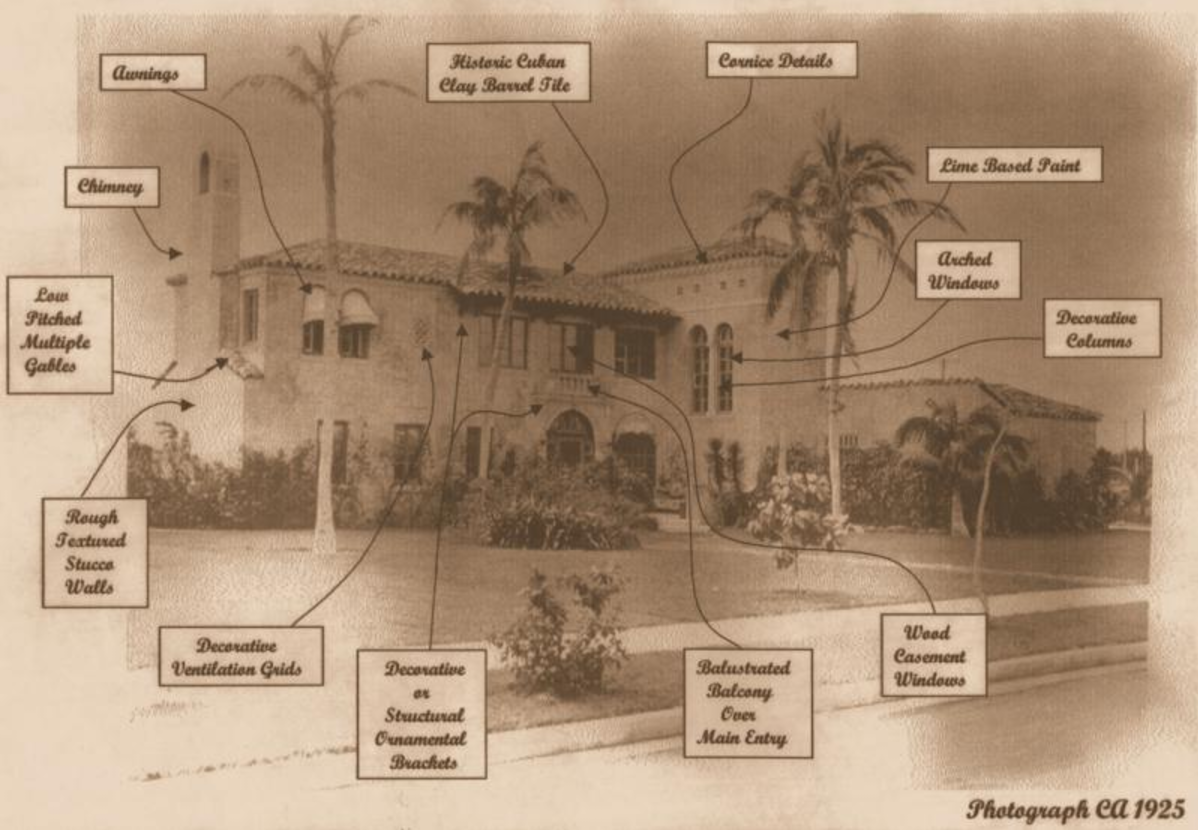
A few years ago, while a board member of the Miami Shores Historic Preservation Board, I created, with the help of other board members, an educational brochure for our community. The brochure included the image shown as well as a brief history of Miami Shores and its development back in the 1920’s. The style popular in South Florida in the 1920’s is now called “Mediterranean Revival” which was influenced by the architecture of the countries bordering the Mediterranean coast, namely Spain, France, Italy and North Africa.
Historic architecture in Miami Shores is comprised of mostly Mediterranean Revival homes and we thought it would be valuable for home owners to be able to identify different elements, learn about them and hopefully inspire them into renovating and restoring our historic core. This same style of architecture can be seen in other historic districts in South Florida like Historic Morningside, Coral Gables, Miami Springs, Historic Bayside, Coconut Grove, and of course Miami Beach. 
The exterior identifying features of these fabulous old houses are shown in the illustration: Historic Cuban Clay Barrel Tile, Cornice Details, Lime Based Paint, arched windows, decorative columns, wood casement windows, balustrated balconies, decorative or structural ornamental brackets, decorative ventilation grids, rough textured stucco walls, low pitched multiple gabled roofs, chimney, and awnings.
Please understand that not all homes have all these features, but we picked a home in Miami Shores that displayed all of these. It is also important to understand that proportion and the manner in which these elements were used is what makes these properties so breathtaking.
Interior floor plans are mostly informal and asymmetrical in arrangement. Arched openings separate main rooms or areas. Ceilings have exposed beams and rafters, some carved, and others painted. Plaster walls have a rough texture.
Over the years many of these homes have undergone alterations to both the exterior and the interior. Yet, despite these changes their distinctive character makes them stand out from those of more recent construction. These historic homes make our Miami Shores Village unique. The restoration of a historic property should be done with a lot of care, patience as well as knowledge. It takes some people years to restore their home to perfection, but the effort is well worth it.
Educating yourself about the features should be an important part of the process. Restorations should be consistent with The Secretary of Interior’s Standards for Rehabilitation. Such standards include examples of correct and incorrect repairs and replacement of roofs, windows, materials and other features.
When restoring a historic home, some people start with windows– I urge all historic home owners to try to get the original floor plans of their home in order to study the proportion of the openings, to see the type of windows originally installed, their vertical nature and the materials. It would not be historically appropriate to install a colonial window in a Mediterranean Revival home.
One controversial topic is replacing wood windows with more modern, metal clad ones. In my opinion, replacement with a better constructed, more durable insolated window is acceptable as long as the opening remains the same, as well as the type of window and proportion of lights and muntins. The same applies to other features and basic knowledge is crucial. For example, you should never install arched awnings over rectangular openings; never replace decorative ornamental metals with different materials like concrete balustrades, always repair decorative and structural columns with the same or similar order; exterior and interior plaster should be matched to look like original.
There are numerous details that should not be overlooked and minor details is what makes the final product. Here are some sketches I did of historic Miami Shores homes.


After reading this article you may be wondering, How does this apply to buying or selling real estate? The answer is simple. When planning to buy or sell a historically relevant home, you should work with a real estate agent that is not only sensitive to historic preservation issues, but someone that understands historic architecture, from materials to features to minor details. I light up when I walk into a historic home and will not only share my knowledge, but will also point out deficiencies and great features for you to know the intricacies of each home and be able to make an educated decision.
**originally published in March 2008**
Comments
11 responses to “Historic Preservation in Miami Shores – Mediterranean Revival architecture”
Once again an excellent written post from you. Keep it up!
I am purchasing a historic home in Miami Shores and need a property inspector with specific knowledge of homes of the era. Do you have a referral?
Much thanks!
Hi David – our resources are part of our services as Realtors and we keep those exclusive to our clients for obvious reasons. I do warn you that you should be checking the structural integrity of the home, so if you are working with an agent, make sure they address that during inspections.
Good Luck with your purchase and hope you do become the lucky owner of one o our historic gems.
Thank you Ines Hegedus-Garcia for your informative article. We just purchased a 1924 Mediterranean Revival home in St. Petersburg. We’ve conducted a lot of research but have only found one resource in Kissimmee (from a Detroit PDF) that suggests a color scheme for the exterior. Any suggestions would be appreciated. Books, online references, anything.
Thank you,
Rick & Karen
Rick and Karen,
I don’t know of any particular books on Mediterranean Revival architecture. My advice is for you to drive around the different historic areas and study the facades of the homes. There was one owner here in Miami Shores that peeled layers of pain off stucco and wood casement windows until he reached the original layer of paint from the time the house was built.
You may also want to read this article I wrote of lime-based paints for Spanish Med homes:
http://www.miamism.com/lime-paints-another-important-element-for-historic-homes/
Hello all,
Thanks for the interesting article above on Mediterranean architecture, which I truely admire and appreciate. Being originally from the Mediterranean, I came across this communication thread, while searching for possible wedding reception venues in the Miami/Ft.Lauderdale/Boca/WPB area that have that Spanish revival feel. Would anyone have any suggestions, apart from the obvious Vizcaya Museum? Many thanks!
Hi Carole,
You have The Biltmore Hotel and also the Spanish Monastery in North Miami Beach (gorgeous by the way). That’s what comes to mind with regards to wedding venues.
Many thanks Ines! I am visiting the Monastery this weekend!
Best Regards.
You’ll love it Carole, the courtyard is gorgeous, I recently attended a wedding there
Guys, this is a great article. I have a question regarding a property I saw recently in the Buena Vista area of Miami. Can someone tell me what architecture the square homes with the stucco walls represent? I know it around the area of Mediterranean/Old-Spanish architecture, but what is it exactly? I would appreciate any comments from the good folks on here.
http://www.zillow.com/homedetails/562-NW-48th-St-Miami-FL-33127/43813459_zpid/
Hi Jorge,
Thanks for visiting Miamism.com and thanks for your comment. I would tell you that those homes are more Mission Style than Mediterranean – very typical of East Buena Vista Historic period. It’s a simplified version, since true Mission usually featured curvilinear parapets or pent roof sections instead of the straight parapets like your example shows – but it’s the beauty of these eclectic, made-up South Florida styles of the early 1900’s.
Hope that helps!